About
A small piece of software for people whose notes are the record their work runs on. It was built by one person, in the oilfield, and it is still built by somebody who uses it every day.
What it is
A place to put a thought the moment you have it, from whichever device is in your hand, and find it later next to the other thoughts it belongs with. Notes, checklists, deadlines, and the people and topics you file them under. It syncs while you watch, works with no signal, and never asks you to choose a folder before you're allowed to write something down.
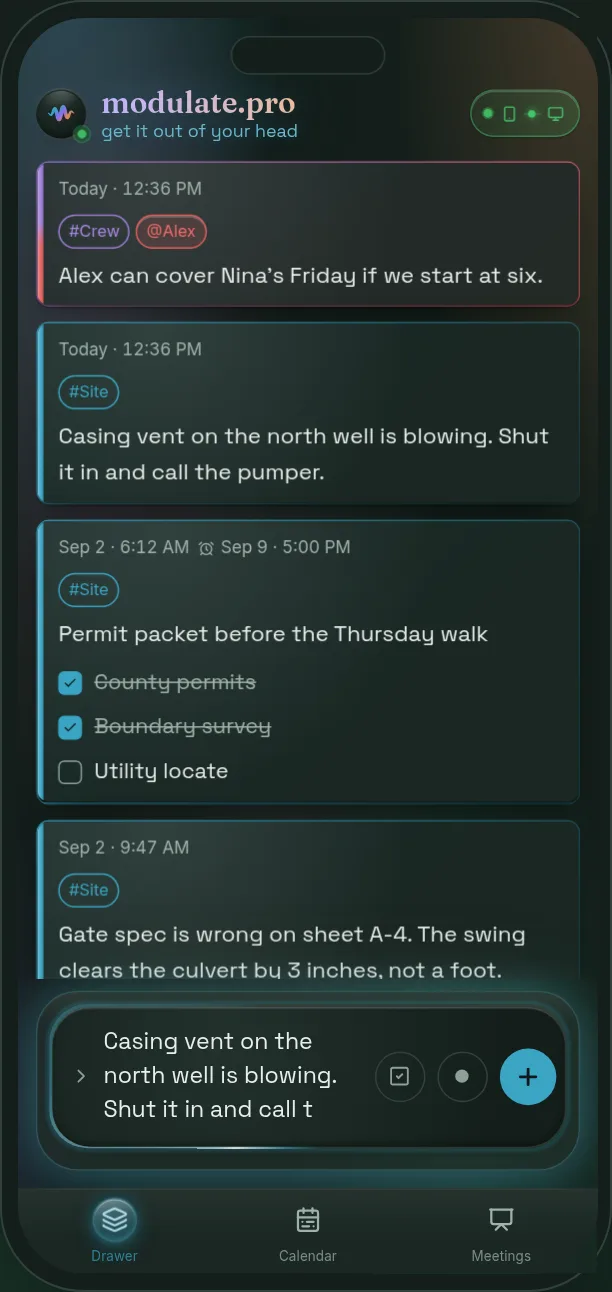
There is also a line down the middle of it. Work on one side, life on the other, chosen once per tag and switched with one control above the filters, so putting a side away takes its notes and its tags with it rather than leaving you to deselect thirty things at six in the evening. You are never asked which side anything is while you are writing it. What has not been decided waits, and gets decided in one sitting at a desk, on the arrow keys.
What it deliberately is not: a project manager, a wiki, or a place to keep documentation. Those exist and are good at what they do. This is for the layer underneath them: the things you would otherwise have kept in your head, or on the back of an envelope, or in a text message to yourself.
Where it came from
It began as one person's own tool, built for one problem and nothing else: get a note down on a phone in the middle of something that cannot stop, and have it waiting on the big screen back at the desk. The something was oilfield work. A well site is a place with no signal, no desk, gloves on, and no patience for an app that wants a folder chosen before it will take a sentence.
That place made the decisions a feature list would not have. It works with no signal because no signal was an ordinary Tuesday, not an edge case. It syncs by itself because nobody standing on location remembers to sync. Writing a note is one motion because the moment was usually mid-task, mid-conversation, or mid-drive between locations, and a thought does not wait for a form. That first version was not much to look at. It got used every day anyway, and everything since is whatever turned out to be missing while using it.
To be clear about what this is not: it is not an oilfield tool. Nothing in it knows what a well is, and most of the people using it have never seen one. But if you are wondering whether a notes app will hold up in a basement, on a plane, or at the school gate, "it spent years being leaned on somewhere with no bars and no second chances" is a better answer than a feature matrix. Where it was built is offered here as the credential, not the audience.
Worth saying plainly, because it explains the shape of the rest. None of this was designed as a product and then filled in; it accumulated in the order the problems actually arrived, and the problems arrived on a well pad.
Where the name comes from
An unfiltered stream of thought is static: always running, mostly formless, gone the moment you stop paying attention. Modulation is what makes a signal carry, imposing structure on a wave so that what you put in can be taken back out somewhere else, later, intact. Writing something down, giving it a tag, putting a person's name on it: that's the same operation. Hence the waveform in the mark, and hence the name.
The decisions it's built on
Products are easier to judge by what they refuse to do than by what they list. These are the refusals. Most of them started as something that got in the way on an ordinary day rather than as a principle, which is why each one is visible in the running software instead of sitting here as a statement of intent.
- No note you write disappears on its own. Notes stay until you archive them, on every plan, and none is deleted because you stopped paying: the free limits simply apply again. The one thing that does expire is stated rather than buried. On the free plan, uploaded images and files are held for 90 days, and you get an email with download links 15 days before any of them goes. The note itself stays, and says the file expired rather than losing it quietly.
- Nothing you already wrote is ever taken away. At the free plan's ceiling of 50 notes, the board stops taking new ones and says so. Everything already in the account stays readable, searchable, editable and completable, forever, on every tier. That is the only refusal in the feature: a plan you stop paying for can cost you what comes next, never what you already did.
- Work is offered, not assigned. You can put an action on somebody's name, and they accept or decline it, with a reason. Most tools in this space will drop a task into another person's queue on your say-so. This one asks them.
- Your prep stays yours. What you meant to raise in a meeting and what was actually said are separate fields, and the first stays private even when everyone else is on the same meeting. The notes are shared; the strategy isn't.
- Leaving is as easy as arriving. Export is free on every plan and returns everything in one file. So is import. A product that is easy to enter and hard to leave is relying on something other than being good.
- Nothing about you is sold. No advertising, and nothing sold or shared with anyone for it. Three things do count what happens here, and they are not the same size, so the short version is worth having straight. The page-view counting is ours and never leaves our servers. A short list of things happening - a board started, a work order finished - goes to a product analytics provider carrying identifiers and counts rather than anything you wrote. And since September 2026 a third one records clicks automatically, which means it also records the text on the thing that was clicked, and inside the product that text is yours. We would rather it did not, and its SDK does not give us the switch. What we could do we did: on these public pages, before there is an account, you can refuse the third one outright and it never starts. Inside the product it is a condition of use, and the terms say so rather than a setting pretending otherwise. The privacy policy names all three, and says the same thing in the register a regulator reads.
Who makes it
modulate.pro is built and operated by Nupik Wenpach LLC. It is small. Small enough that the address at the bottom of this page reaches a person who can change the software, and small enough that there is no support department to be routed through.
That cuts both ways, and the security page is blunt about which ways. There is no SOC 2 report and no 24-hour on-call rota. There is also nobody who has to be convinced that a bug you reported is worth fixing.
Where it's going
Being told what is coming is worth less than being told what is here, so the rule this site follows is that anything not built yet is marked as not built yet: on the pricing page, in the comparison table, and next to the plan that would include it. Nobody is charged for a feature that doesn't exist.
What that leaves is a straightforward promise rather than a roadmap: the product gets better in the direction of the people using it, which is the only way it has ever been built, and you can always take everything you've written and go somewhere else.
Getting in touch
Write to noah@nupikwenpach.com with questions, problems, feature requests, or to tell us we've got something wrong. It is read by a person, and you will get a reply from one.